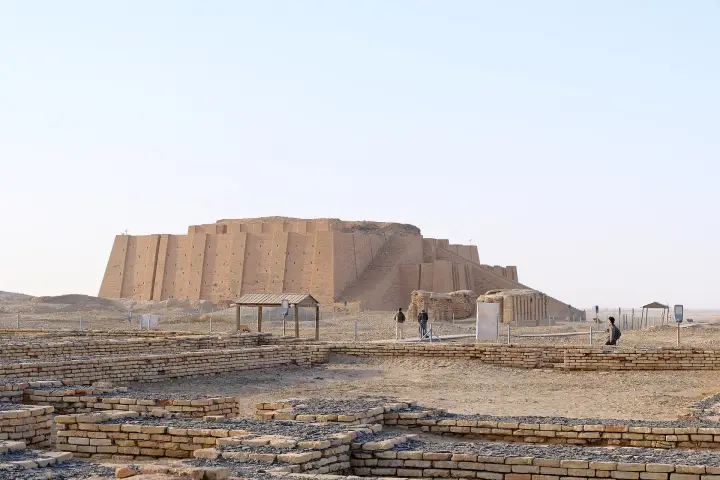
The Ziggurat of Ur, Dhi Qar. Photo: Alli Khalil, licence CC BY-SA 4.0, source.
Why it matters
Ur is one of the key cities of the ancient world because it holds many chapters of southern Iraq's history in one place. Its ziggurat, built by Ur-Nammu, is among the best preserved, and shows us what Mesopotamia's stepped temples looked like. In the Royal Cemetery, Leonard Woolley found jewellery, musical instruments and games that rank among the masterpieces of Sumerian art and are still shown in museums worldwide. Ur was also the capital of the Third Dynasty of Ur, which left thousands of administrative tablets and the oldest known law code. For these reasons UNESCO included it in the Ahwar World Heritage site in 2016.
A great Sumerian city, capital of the Third Dynasty of Ur and centre of the cult of the moon god Nanna. Its ziggurat, built by King Ur-Nammu, is one of the best preserved in the world.
Leonard Woolley excavated it between 1922 and 1934 for the British Museum and the Penn Museum, uncovering the Royal Cemetery, some 4,500 years old. In 2016 UNESCO included it in the Ahwar World Heritage site.
Notable factIn the Royal Cemetery, kings were buried with their attendants, along with jewellery, musical instruments and board games that still amaze museum visitors.
Amer and this site: Director of the World Heritage sites of Ur and Eridu since 2026; in November 2026 he attended the opening of the site's visitor centre.
Visitor guide
17km from Nasiriyah
50km from Shatra
Approximate straight-line distance; the road is longer.
Best time: Roughly November to March. Summers in the south are extremely hot, often above 45°C, so avoid midday visits in summer.
Practical tips:
Arrange your visit in advance with the Dhi Qar Antiquities Inspectorate; archaeological sites are protected and guarded.
Bring plenty of water, a hat and sun protection; most sites have no shade or services.
Do not walk on exposed walls or pick up any sherd or stone; Iraq's Antiquities and Heritage Law No. 55 of 2002 forbids it.
Getting there
About 16 km south-west of Nasiriyah. It is the easiest southern site to visit, with a visitor centre and a site-management building.
Photos of the site
The Ziggurat of Ur in 2005. Photo: Hardnfast, licence CC BY 3.0, source.Game pieces from the Royal Cemetery at Ur, British Museum. Photo: Gary Todd, licence CC0, source.The Great Ziggurat of Ur (temple of the moon god Nanna) near Nasiriyah, built by Ur-Nammu around 2100 BCE. Photo: Michael Lubinski from Green Bay, WI, USA, licence CC BY-SA 2.0, source.The front facade of the Ziggurat of Ur with its three staircases, Nasiriyah. Photo: Alli Khalil, licence CC BY-SA 4.0, source.The stepped wall of the Ziggurat of Ur with the sun behind the summit, Nasiriyah. Photo: Alli Khalil, licence CC BY-SA 4.0, source.The Ziggurat of Ur and the remains of the Temple of Ningal beside it. Photo: Alli Khalil, licence CC BY-SA 4.0, source.The main staircase of the Ziggurat of Ur in the light of late afternoon. Photo: Alli Khalil, licence CC BY-SA 4.0, source.Foundations of residential and religious buildings at Ur, with the ziggurat on the horizon. Photo: Alli Khalil, licence CC BY-SA 4.0, source.Burial chambers of the Royal Cemetery at Ur (about 2600 BCE). Photo: Alli Khalil, licence CC BY-SA 4.0, source.Rows of fired brick paving the floor of a building at Ur. Photo: Alli Khalil, licence CC BY-SA 4.0, source.The arched doorway of the E-dublamah temple at Ur. Photo: Alli Khalil, licence CC BY-SA 4.0, source.Sunset from the top of the Ziggurat of Ur. Photo: DVIDSHUB, licence CC BY 2.0, source.The Queen's Lyre from the Royal Cemetery at Ur, British Museum (نحو 2500 ق.م). Photo: Osama Shukir Muhammed Amin FRCP(Glasg), licence CC BY-SA 4.0, source.The Ur bull-headed golden lyre, Penn Museum (2550–2450 ق.م). Photo: Mary Harrsch, licence CC BY 2.0, source.The Standard of Ur, Peace Panel (banquet and procession), British Museum (نحو 2600 ق.م). Photo: Juan Carlos Fonseca Mata, licence CC BY-SA 4.0, source.The Standard of Ur, War Panel, British Museum (نحو 2600 ق.م). Photo: Unknown author, licence Public domain, source.'Ram in a Thicket' from the Royal Cemetery at Ur, Penn Museum (نحو 2600 ق.م). Photo: Benjamin82877, licence CC BY-SA 4.0, source.Gold helmet of Meskalamdug from the Royal Cemetery at Ur (displayed replica) (نحو 2500 ق.م). Photo: Akieboy, licence CC BY-SA 2.0, source.The Ziggurat of Ur before restoration, Matson Collection, Library of Congress (نحو 1932). Photo: Matson Collection (Library of Congress), licence Public domain, source.The Ziggurat of Ur from the southeast, Matson Collection (نحو 1932). Photo: Matson Collection (Library of Congress), licence Public domain, source.The Ziggurat of Ur from the northwest, with the excavations of the adjacent temple, Matson Collection (نحو 1932). Photo: Matson Collection (Library of Congress), licence Public domain, source.